Ratios
Profit Margin (Net Margin)
Net Income divided by Revenues

Also known as Net Profit Margin
Gross Margin

Sales margins are often called gross profit margins
Return On Assets - ROA (return on investment)
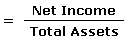
The ROA is often referred to as ROI
The assets of the company are comprised of both debt and equity.
The assets of the company are comprised of both debt and equity.
Note: Some investors add interest expense back into net income when performing this calculation because they'd like to use operating returns before cost of borrowing.

Return On Capital Employed - ROCE
ROCE should always be higher than the rate at which the company borrows, otherwise any increase in borrowing will reduce shareholders' earnings.
A variation of this ratio is return on average capital employed (ROACE)
Return On Equity - ROE
Return on Equity = Net Income/Shareholder's Equity
return on common equity (ROCE) = net income - preferred dividends / common equity
dividing net income byaverage shareholders' equity
return on common equity (ROCE) = net income - preferred dividends / common equity
dividing net income byaverage shareholders' equity
Shareholder's equity does not include preferred shares.
Also known as "return on net worth" (RONW)
- If new shares are issued then use the weighted average of the number of shares throughout the year.
- Averaging ROE over the past 5 to 10 years can give you a better idea of the historical growth.
Also known as "return on net worth" (RONW)

